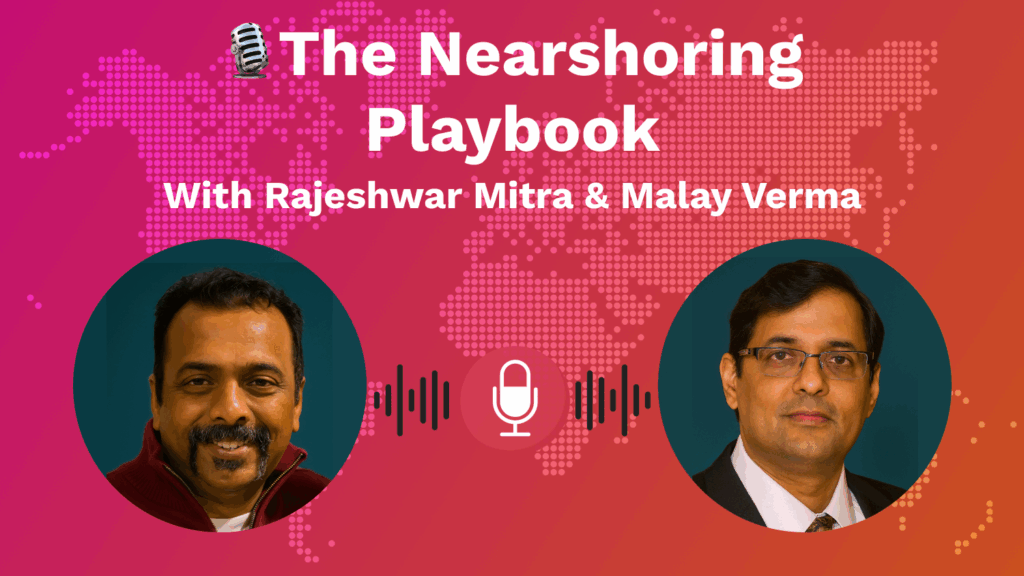
In the latest episode of The Nearshoring Playbook, hosted by Arjun, the discussion with Malay Verma and Rajeshwar Mitra, co-founders of Greymatter Innovationz, dives deep into one of the most overlooked aspects of global business growth — building successful nearshore operations in Latin America (LATAM).
While global enterprises increasingly recognize LATAM as the next major powerhouse for nearshoring, many miss critical nuances that determine whether their expansion thrives or falters in the first 6–12 months.
The Biggest Mistake: Treating Nearshoring Like Outsourcing
According to Rajeshwar Mitra, the single biggest mistake companies make is approaching nearshoring like a rebranded outsourcing contract.
Organizations often set up a site quickly and operate it as a vendor arrangement, keeping it separate from the enterprise. This siloed approach undermines the very purpose of nearshoring — which is to create an integrated extension of the organization, not an isolated offshore unit.
Mitra emphasizes that companies must build career paths, integrate culture, and invest in leadership from the start. Otherwise, high attrition becomes inevitable, as local teams fail to connect with the employer’s culture and long-term vision.
Another critical pitfall is over-indexing on cost advantage. While LATAM offers 30–40% savings compared to U.S. operations, a myopic focus on cost-per-head limits growth potential. Success in nearshoring requires balancing cost, speed, compliance, and innovation — not just short-term savings.
Underinvestment in Leadership: A Short-Sighted Approach
Malay Verma echoes these insights, noting that many enterprises still treat nearshoring as a tactical, short-term move rather than a strategic, long-term investment.
Organizations focusing solely on labor arbitrage often fail to establish the leadership frameworks needed to sustain and scale operations.
“Underinvestment in leadership is a very short-term view,” Verma observes. Building a resilient nearshore practice requires local leadership, structured innovation hubs, and the nurturing of young talent — or what he calls ‘rookies’ — who can grow into future leaders.
Leadership forms the backbone that anchors teams operating across cross-border, on-site, offshore, and nearshore environments. Without it, companies risk operational misalignment, poor integration, and disengaged talent.
Cultural Replication: Why “Copy-Paste” Models Fail
Another major oversight in LATAM expansion is attempting to replicate successful India-based models in an entirely different region.
Many enterprises bring in expat delivery leaders who neither understand the local language nor the cultural context, expecting the same systems to work. This approach often backfires.
As Verma explains, “While processes can be replicated, culture cannot.” Each LATAM country has unique cultural, social, and business norms, as well as distinct labor and compliance frameworks. Successful companies invest time in understanding local nuances and ensuring their workforce feels integrated and empowered.
At Greymatter Innovationz, almost 100% of the workforce comprises local professionals, which helps bridge cultural gaps and strengthen organizational cohesion.
Leadership and Integration: The Real Success Formula
The hosts underscore that integrating leadership across on-site, offshore, and nearshore teams is the cornerstone of a thriving nearshore setup.
Building the right layer of integration between global and regional teams enables consistency in goals, processes, and performance expectations.
Selecting the right partner to help establish and scale LATAM operations also plays a defining role. The partner must not only provide access to talent but also guide organizations in leadership development, alignment of processes, and creation of sustainable career pathways.
Moreover, nurturing a continuous pipeline of young STEM graduates ensures the nearshore ecosystem remains energized, innovative, and ready to grow with evolving business needs.
Recipe for Long-Term Success
The conversation concludes with a powerful analogy. “It’s not just about having the ingredients,” remarks Arjun, “but about the process — how you put them together.” Nearshoring success is a recipe, combining leadership, culture, integration, and local understanding into a cohesive, adaptable operation.
As Verma summarizes, “When you rely on leadership first, everything else naturally aligns.”
Businesses seeking to nearshore to LATAM must look beyond short-term labor gains and instead focus on building integrated, leadership-driven, culturally aligned centers that foster trust, innovation, and long-term value.